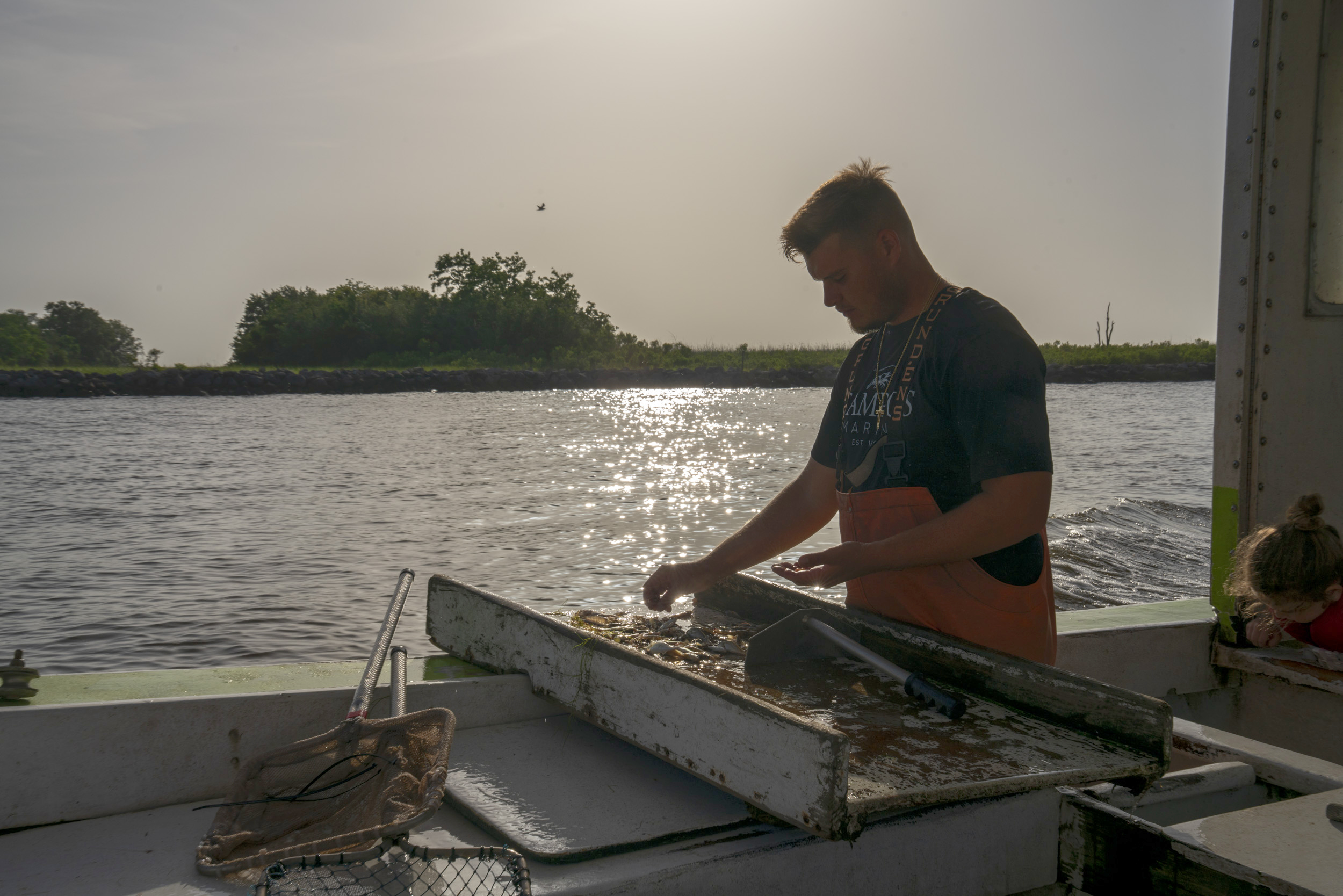
Louisiana Shrimpers
Fight to Save Their Industry
Cheap imported shrimp, environmental degradation, and rising fuel costs are
collapsing the seafood economy in the Mississippi Delta.
Locals say government intervention and consumer support could change that.
By Jake Price and Olivia Shaffett
Along the Gulf Coast of Louisiana, where the mighty Mississippi flows into the ocean and seeps into mile after mile of marshy delta, the waterways teem with shrimp, crabs, oysters and finfish. This area, wryly dubbed “the end of the world” by locals, has depended on the seafood industry, both culturally and economically, since the late 1800s. Shrimping is particularly important; 25 percent of all shrimp consumed in the U.S. comes from Louisiana.
But for 20 years, that industry has been in decline. Shrimpers along the Gulf Coast have struggled to compete with cheaper imported shrimp, endured environmental devastation—particularly the aftermath of the 2010 BP Deepwater Horizon oil spill, which flooded the Gulf with toxins and decimated marine life populations—and dealt with rising fuel costs, among other challenges.
In the 1980s, shrimpers could sell a pound of shrimp for about $4.50 (adjusted for inflation). In recent years, they have been lucky to get $1.50.
Rocky Ditcharo, a seafood wholesaler and the owner of Ditcharo D Jr. Seafoods in Buras, Louisiana, worries for the industry’s future if domestic shrimp prices continue to decline. “If we can’t cap imports, if there is no solution,” he says, “then this industry dies in 20 years.”
Along the Gulf Coast of Louisiana, where the mighty Mississippi flows into the ocean and seeps into mile after mile of marshy delta, the waterways teem with shrimp, crabs, oysters and finfish. This area, wryly dubbed “the end of the world” by locals, has depended on the seafood industry, both culturally and economically, since the late 1800s. Shrimping is particularly important; 25 percent of all shrimp consumed in the U.S. comes from Louisiana.
But for 20 years, that industry has been in decline. Shrimpers along the Gulf Coast have struggled to compete with cheaper imported shrimp, endured environmental devastation—particularly the aftermath of the 2010 BP Deepwater Horizon oil spill, which flooded the Gulf with toxins and decimated marine life populations—and dealt with rising fuel costs, among other challenges.
In the 1980s, shrimpers could sell a pound of shrimp for about $4.50 (adjusted for inflation). In recent years, they have been lucky to get $1.50.
Rocky Ditcharo, a seafood wholesaler and the owner of Ditcharo D Jr. Seafoods in Buras, Louisiana, worries for the industry’s future if domestic shrimp prices continue to decline. “If we can’t cap imports, if there is no solution,” he says, “then this industry dies in 20 years.”
On a sweltering summer day, while shrimp boats idle in his docks, Ditcharo stands inside one of his freezer rooms, where a massive machine spits out ice chips for packing shrimp. As demand for domestic shrimp has fallen, his second freezer room has gone unused. Over the past two years, Ditcharo has spent $170,000 to upgrade and maintain these rooms, putting even more strain on his already stressed finances.
Ditcharo, along with the Louisiana Shrimping Association, believes some form of governmental intervention—whether quotas, import caps, or higher tariffs—is needed to curtail the high volume of imported shrimp.
Through the farm bill, farmers and ranchers receive financial assistance in the form of crop insurance, subsidy payments, and conservation programs. But shrimpers and other seafood producers do not receive similar relief. “If [the government] subsidizes [shrimping] . . . It might bring in younger people,” Ditcharo says. “It’s a lot of money to go out and buy a boat and all the equipment on your own.”
Without help, Ditcharo fears the industry will collapse. “The small boats will go first, then the larger vessels. Then, a few smaller wholesalers and retailers. I’ll hold off as long as I can. But eventually, I’ll have to shut down, too.”
George Barisich is the kind of person you hear before you see. He can tell stories for hours, regaling you with tales of growing up catching oysters like his Croatian ancestors did, and of facing one catastrophe after the next, like the fire that took the Peruga, his beloved shrimp boat, in 2020.
A fourth-generation fisherman and the president of the United Commercial Fishermen’s Association, Barisich started working the waters with his father when he was just 10 years old. Life was hard, but it had its freedoms. When the fishing was good, the school year ended early, and Barisich would eagerly join his father aboard the FJG, named for Barisich and his siblings (Frances, Joseph, and George). “The boat is the same age as me. My dad bought it for shrimping the same year I was born.” Out on the water, he accumulated a lifetime of knowledge that was hard-earned, deeply rooted, and irreplaceable.
That knowledge has allowed Barisich to be both a guardian and a leader in his community, a source of wisdom for fellow shrimpers and fishers in times of crisis. Whether it was fighting BP for reparations after the 2010 oil spill or testifying for capped imports before Congress, Barisich has championed the interests of Louisiana’s seafood industry for more than three decades. “We need more gladiators out there,” Barisich says. “We need more people in the industry speaking out for us.”
Barisich and his fellow seafood producers fought the state of Louisiana on a controversial, long-held plan to build a new freshwater diversion in Barataria Basin called the Mid-Barataria Sediment Diversion (MBSD). The state intended for the MBSD to rebuild rapidly disappearing land over the course of 50 years by flooding the basin with fresh water and sediment from the Mississippi River. Ecologists supported this plan as a way to restore wetlands vital to migrating birds and many other species, and to mitigating the impact of storms.
Opponents to the MBSD argued the diversion would force seafood producers out of their livelihoods, pointing to an environmental impact report from the U.S. Army Corps of Engineers that projected “major, adverse impacts” on oyster and brown shrimp populations. In July, the state terminated the diversion, with plans to explore reinstating another, smaller diversion project in Myrtle Grove.
Even though the Barataria diversion has been canceled, Barisich shares Ditcharo’s fear of a dying industry if the price of domestic shrimp does not provide a living wage. “I’m the last Barisich who will shrimp in these waters,” he says. “Our universe is so small now, it scares me. The average captain’s age is 54. That’s not good.”
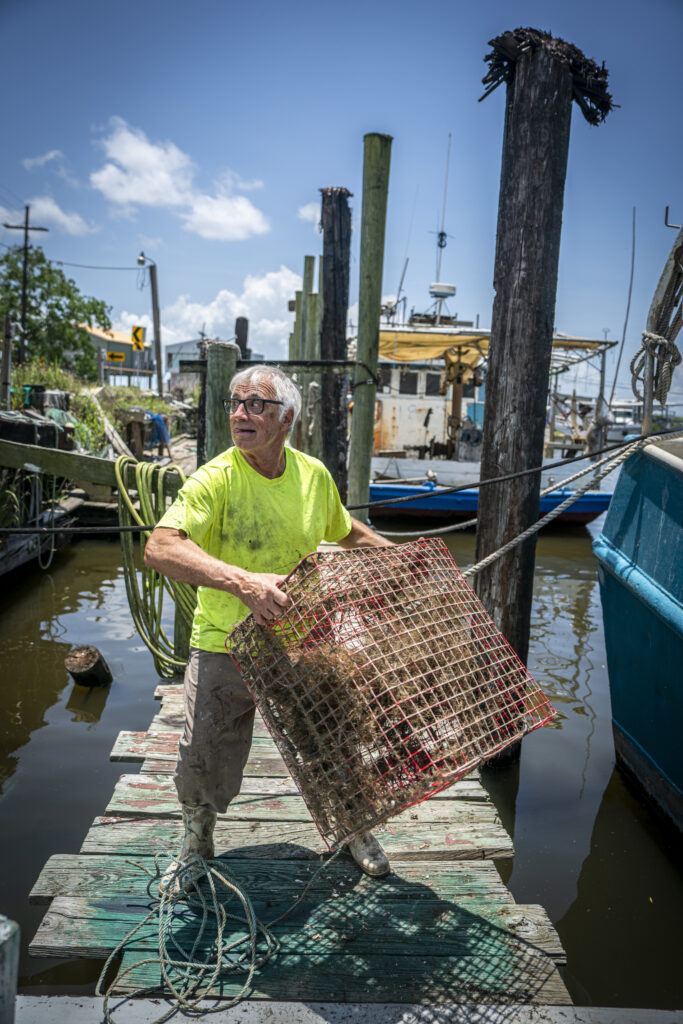
From Boat to Table
For commercial shrimping on the Gulf Coast to continue, the burden cannot fall solely on those on the water. Community leaders, government officials, and local consumers all have a part to play in keeping the industry alive. Few people seem to understand the responsibility of supporting Louisiana’s seafood producers more than chef Dana Honn.
“A lot of the problems that we’re seeing with our coastal communities right now stem from relationships that have been severed between the public and coastal communities over a period of 100 years,” Honn says. “Part of [our work] is making sure that there’s a connection between the chef and the producer and the consumer—that whole chain.”
Honn has worked to establish those connections by volunteering for Chefs on Boats, an immersive educational program that takes chefs and foodservice workers out on the Gulf to catch oysters, shrimp, and fish with local fishermen. “I’ve been lucky enough to see oyster shuckers out there seeing the process of catching the oysters for the first time,” says Honn. “It can be life-changing, because it infuses what they do with purpose and history.”
Honn argues that awareness of sourcing and consuming seafood from the Gulf needs to move beyond regional boundaries. “We know a 5 percent change in market share from farmed to domestic would have a massive effect throughout the Gulf South. That may not sound like a whole lot, but it would be a huge shift for the industry.”
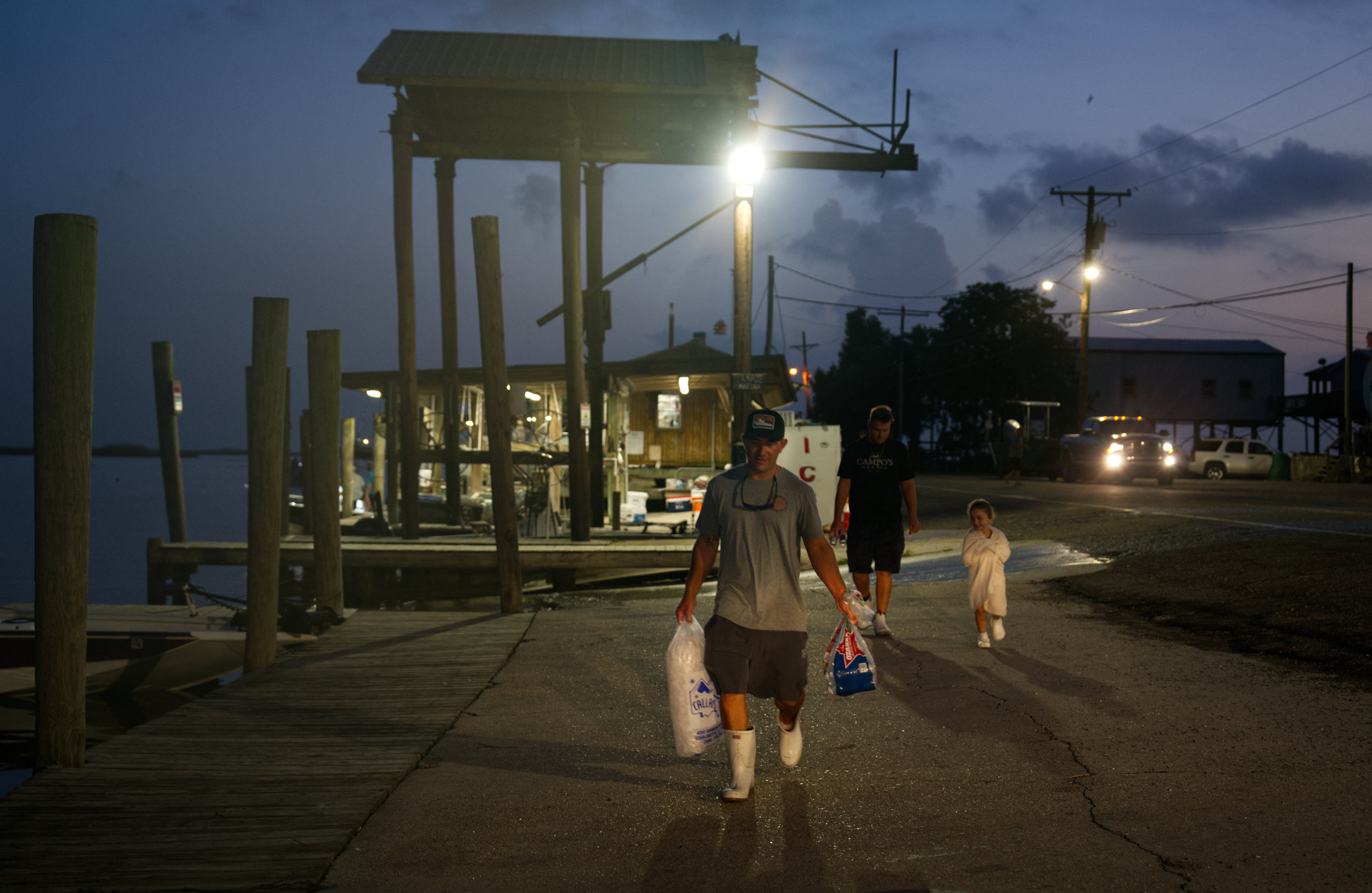
Zack Campo:
The Next Generation
Shrimping on the Gulf Coast is a multi-generational industry. Now it’s experiencing a longevity crisis as older shrimpers, wearying of the many challenges they face, dissuade their children from joining the family business on the water.
Still, a few tenacious shrimpers are passing the nets on to the next generation.
Zack Campo is one of the youngest shrimpers operating in the area. A fifth-generation shrimper, Campo primarily catches bait shrimp for his family’s esteemed 122-year-old marina in Shell Beach, Campo’s Marina.
And for shrimpers, the price of shrimp will help determine the industry’s future. Louisiana has just opened its in-shore white shrimp season as tariffs begin to take hold.
Right now, all eyes are on prices at the docks.
***
Editor’s note: This article was updated on August 28, 2025, to include new information regarding radiation-tainted foreign shrimp.